Clinical modules

Each module solves a concrete clinical problem.

The platform modules are presented as individual areas with a real use case, solved problem, advantage, and clear boundaries — for nursing homes, psychiatric units, and coordinated care.

  • Encounter-based documentation instead of disconnected forms
  • Psychiatric findings with structured psychopathology block
  • Assessments captured digitally, tracked over time, integrated into care plans

Module overview

Not a generic feature list — concrete care solutions.

Each module is described with its clinical problem, the solution mechanism, the resulting advantage, and the scope of public communication.

Platform

Clinical Documentation Platform

Every nursing note, physician finding, and medication decision is tied to a patient encounter and visible in the longitudinal care record — not as an isolated form.

Challenge

Clinical teams document in disconnected forms with no link to the patient's full history. Handovers are error-prone, care continuity breaks down, and decision-making suffers.

Solved problem

Every encounter, diagnosis, and intervention is linked to a patient and visible in a longitudinal timeline — role-filtered for nurses, physicians, and therapists.

Advantage

Less documentation loss, faster handovers, stronger clinical decision support, and a reliable picture of each patient across the full care episode.

What we show
  • Longitudinal patient profile and timeline view
  • Encounter-based documentation for all entry types
  • Clinical notes, wound documentation, and care plans
  • Medication management with titration and follow-up planning
  • Scheduling, tasks, and follow-up actions
What we do not show
  • Internal admin screens and system configuration panels
  • Protected patient records without authentication
  • Raw database structures or workflows that only make sense after login

Clinical

Psychiatric Documentation

Structured psychiatric documentation with anamnesis, psychopathology, and recommendation blocks — fully anchored in the encounter and visible by role.

Challenge

Psychiatric conversations, anamneses, and clinical findings are often documented inconsistently or not integrated into the patient record at all.

Solved problem

Psychiatric consultations are captured as complete encounters — with a structured psychopathology block, anamnesis block, recommendation block, and follow-up planning inside a defensible clinical record.

Advantage

Better longitudinal documentation, a legally sound clinical record, clearer team communication, and faster preparation of discharge letters and reports.

What we show
  • Psychiatric first consultation and anamnesis as an encounter
  • Structured psychopathology assessment (consciousness, orientation, mood, drive, suicidality)
  • Recommendation block with medication proposal and titration plan
  • Follow-up planning with responsibility and priority
  • Role-based visibility split between psychiatric and nursing documentation
What we do not show
  • Diagnoses or health data in any public channel
  • Clinical intake questionnaires on the open website
  • Protected treatment documents without authentication
Assessment

Assessments & Diagnostics

MMSE, Barthel Index, GDS, NRS, Braden scale, and other standardized assessments are captured digitally, tracked across time, and integrated into the care plan.

Challenge

Standardized assessments are often still done on paper, not anchored to the patient record, and nearly impossible to analyze for management or quality control.

Solved problem

Structured assessments are captured digitally with score, interpretation, and individual item values in the patient timeline — comparable over time and auditable for quality management.

Advantage

Complete assessment history, direct longitudinal comparison, stronger basis for care level grading, care planning, and clinical decision-making.

What we show
  • MMSE, Barthel Index, GDS (Geriatric Depression Scale)
  • NRS (Numeric Pain Rating Scale), Braden Scale
  • Score-based evaluation with interpretation and item breakdown
  • Digital timeline view with trend comparison
  • Integration into care plan, report, and discharge letter
What we do not show
  • Real patient data on the public site
  • Internal scoring logic without clinical context
  • Assessment results outside the embedded patient record
Business Value

Operational Value & ROI

Less documentation overhead, better handover quality, clear compliance foundation — tangible operational value for leadership, operators, and procurement.

Challenge

Health-tech investments often stall because the concrete operational value is not visible to decision-makers early enough.

Solved problem

Clearly communicated value for care teams and facility management: less documentation redundancy, better handovers, auditable quality indicators, and revision-safe records.

Advantage

Faster procurement decisions, better demo quality, and a direct path from the website into a real conversation with operators, clinical leadership, or investors.

What we show
  • Operational relief for nursing and medical staff
  • Compliance benefits through audit logs and revision-safe records
  • Quality management foundation through digital assessment history
  • Clear boundary between public story and protected product
What we do not show
  • Inflated KPI slides with no clinical substance
  • Generic startup language disconnected from real care problems
  • Features without embedding in clinical context
Nursing home
Psychiatric clinic
Outpatient practice

Audiences

Readable for providers and people alike.

The same platform answers different questions for facility leadership, clinical teams, and people looking for orientation.

Who the platform works for

B2B for decisions, B2C for orientation.

The platform page combines clinical credibility, operational value, and a calm first contact — without exposing the protected care environment.

B2B understands the clinical architecture

Leadership, operators, and partners see how documentation, psychiatry, assessments, and business value fit together.

  • Patient-centered architecture as the core design principle
  • Role-based visibility as the governance foundation
  • Clear module boundaries for conversations and demos

B2C understands the entry point

People visiting psychotherapy and diagnostics see only what matters for orientation and first contact.

  • No clinical intake on the public site
  • No sensitive health data in the first form
  • Calm, direct first contact with a clear next step
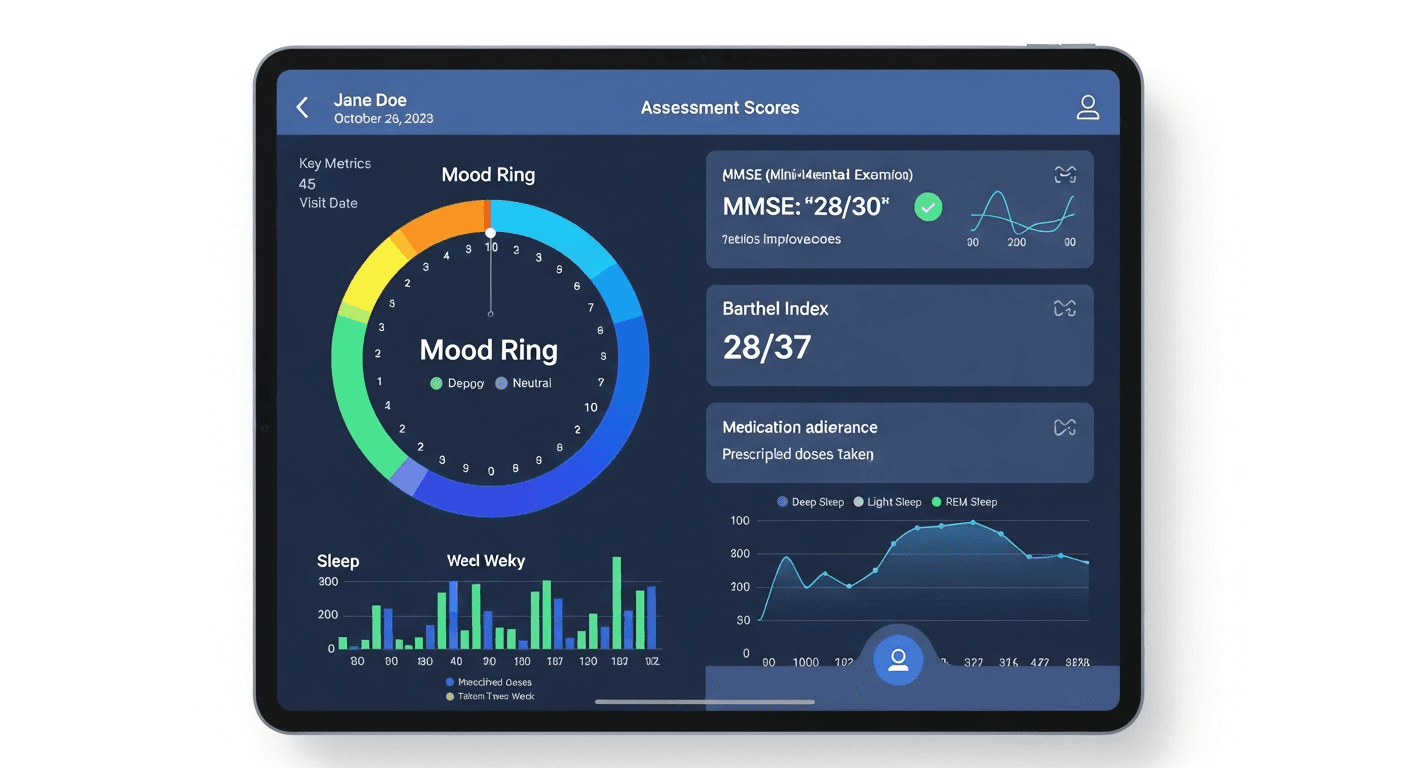
Digital assessment interface with MMSE and Barthel

Assessments

MMSE · Barthel · Braden · NRS · GDS – structured input, longitudinal trend.

Quality principles

What every module must deliver.

Every module follows the same framing rules: real problem, mechanistic solution, tangible advantage.

What every module needs to show

A strong platform page shows not only outcomes but the clinical thinking behind the solution.

  • A concrete clinical problem

    Every module starts with a real care delivery problem — not a generic feature description.

  • A solved problem with a mechanism

    The module card explains which friction is removed and why the solution holds up clinically.

  • A tangible operational advantage

    Value is expressed in language that teams, leadership, and operators can use immediately.

What the platform intentionally does not show

The strongest public story comes from good boundaries, not maximum exposure.

  • No internal admin or configuration screens

    System internals stay internal and do not burden the first contact.

  • No protected patient data

    Module pages stay credible and safe because they never expose sensitive material.

  • No empty buzzwords

    Every module addresses real clinical impact instead of generic startup language.

Why this format works better

Module stories are easier to remember, easier to present, and easier to bring into a clinical conversation.

  • Better demo preparation

    Prospects understand the platform frame before the meeting and arrive with real questions.

  • Stronger positioning

    Documentation, psychiatry, assessments, and business value each get their own memorable role.

  • Less overload

    The website stays focused because every card shows only what is necessary.

System quality

Stable in both languages. Stable in both themes.

Structure, localization, and theming stay consistent across all modules.

Structured

Every module follows the same clinical framing.

Problem, solution, advantage, visible content, and hidden content are structured consistently across all modules.

Localized

All module stories work in German and English.

The structure is identical in both languages for consistent B2B and B2C communication.

Theme-ready

The layout works in light mode and dark mode.

Module cards maintain clear hierarchy and strong contrast in either theme.